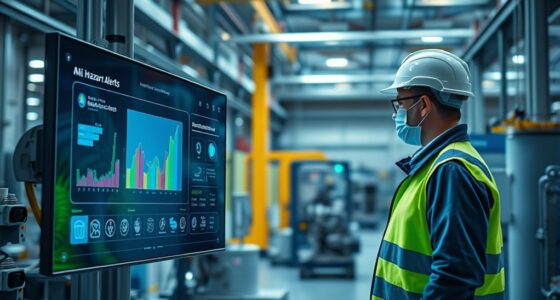
VR and AR in safety training help you experience hazards and machinery virtually, offering an immersive way to learn essential safety procedures. You can practice responding to emergencies, recognize hazards more effectively, and build confidence in handling equipment—all in a controlled environment. These technologies allow training to be customized to your specific role and risks, making the learning more effective. Keep exploring to discover how these advances could transform your safety programs even further.
Key Takeaways
- VR and AR provide immersive, hands-on safety training that surpasses traditional classroom methods.
- They simulate real-world hazards and equipment operation in a risk-free environment.
- Customizable scenarios target specific roles and hazards, enhancing relevance and preparedness.
- These technologies improve hazard recognition, decision-making, and situational awareness.
- Overall, VR and AR lead to better knowledge retention, safer work environments, and practical skill development.

Virtual reality (VR) and augmented reality (AR) are transforming safety training programs by providing immersive, hands-on experiences that traditional methods can’t match. With these technologies, you can encounter virtual hazards in a controlled environment, allowing you to practice responses without risking real injury or damage. This realistic exposure helps you recognize potential dangers more effectively than classroom lectures or static videos. When you engage in equipment simulation via VR or AR, you gain practical experience operating machinery or handling tools in a safe, repeatable setting. These simulations replicate real-world scenarios, so you can develop your skills and confidence before stepping onto an actual site.
VR and AR equipment simulations provide safe, realistic practice for operating machinery and handling tools.
Incorporating virtual hazards into your training means you experience emergency situations, like fires or chemical spills, in a way that feels authentic. You learn to identify warning signs, follow safety protocols, and make quick decisions—all without putting yourself in real danger. This immersive approach enhances your situational awareness, making it easier to recall procedures when faced with actual hazards. By confronting virtual hazards regularly, you build muscle memory and improve your ability to respond calmly under pressure. The realism of these simulations also helps you understand the severity of certain risks, reinforcing the importance of safety measures and proper equipment use.
Equipment simulation through VR and AR allows you to practice operating complex machinery, such as cranes, forklifts, or industrial tools, in a risk-free environment. You can manipulate controls, troubleshoot issues, and learn maintenance procedures without the fear of making costly mistakes. These simulations often include real-time feedback, guiding you to correct errors and perfect your techniques. As a result, you develop a deeper understanding of equipment functionality and safety protocols, which translates into safer practices when you’re using the actual equipment on the job site.
What makes VR and AR especially effective is their ability to tailor scenarios to your specific needs. Whether you’re a new employee or experienced worker, you can undergo customized training modules that focus on the hazards most relevant to your role. This targeted approach ensures you’re better prepared and less likely to overlook critical safety steps. Additionally, considering the support hours of training programs can help you plan your sessions effectively, ensuring consistent practice and reinforcement of safety procedures. Overall, integrating virtual hazard scenarios and equipment simulation into your safety training enhances your learning experience, increases retention, and ultimately creates a safer work environment. You’re not just learning theory—you’re practicing realistic, life-like situations that prepare you for real-world challenges.
Frequently Asked Questions
How Cost-Effective ARe VR and AR Safety Training Solutions?
VR and AR safety training solutions are highly cost-effective because they offer significant cost savings by reducing the need for physical materials, travel, and on-site trainers. Your investment provides a high return through repeated use, scalable training sessions, and improved retention. Over time, these technologies lower training expenses and decrease safety incidents, making them a smart financial choice for your organization.
What Industries Benefit Most From VR and AR Safety Training?
You’ll find manufacturing and construction industries benefit most from VR and AR safety training, like a sturdy bridge over dangerous waters. These tools help workers master manufacturing safety protocols and construction hazard prevention without real-world risks. By immersing employees in realistic scenarios, you enhance safety awareness and accident prevention. This innovative approach guarantees your team is better prepared, reducing injuries and increasing overall safety standards across these high-risk sectors.
How Do VR and AR Improve Long-Term Safety Retention?
VR and AR boost your long-term safety retention by making training more engaging, which helps reinforce learning. These technologies enhance memory retention through immersive experiences that mimic real-life situations, making it easier for you to remember safety protocols. As a result, you stay more engaged and retain critical safety information longer, reducing accidents and fostering a safer work environment.
ARe There Any Health Risks Associated With Prolonged VR or AR Use?
Prolonged VR or AR use can pose health risks like eye strain and vision health issues, especially if you don’t take regular breaks. You might also experience motion sickness or dizziness if your body struggles to reconcile visual cues with physical sensations. To minimize these risks, limit session durations, ensure proper equipment fit, and follow recommended guidelines. Staying attentive to your comfort helps you enjoy the benefits without jeopardizing your health.
How Customizable ARe VR and AR Safety Training Modules?
Imagine crafting a safety training saga as flexible as a yoga master—your modules are highly customizable. Thanks to personalization options and modular design, you can tailor each experience to fit specific hazards and learning styles. Want a quick refresher or an in-depth scenario? No problem! You hold the power to adapt, ensuring your training stays relevant, engaging, and as unique as your workplace’s fingerprint.
Conclusion
Incorporating VR and AR into safety training can boost retention rates by up to 75%, making your programs more effective. Imagine reducing workplace accidents markedly by immersing your team in realistic, hands-on scenarios. These technologies aren’t just innovative—they’re transforming safety training into a more engaging and impactful experience. Embrace VR and AR now, and see how you can create a safer, more prepared workforce that’s ready for anything.