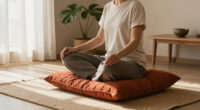
Choosing a spiritual meditation cushion is less about finding the most symbolic design and more about deciding what your body needs on the floor. A zafu is a compact, raised cushion that lifts the hips; a zabuton is a broad mat that cushions the knees, ankles, and feet. They are often compared as alternatives, but they do different jobs and can also be paired.

Turn your quiet moments into listening time
- Thousands of audiobooks, podcasts and originals
- Listen on your phone, tablet or Echo — also offline
- Cancel anytime

Retrospec Sedona Zafu Meditation Cushion with Buckwheat Hulls
- ✔ Shape: Zafu meditation cushion
- ✔ Dimensions: 17 x 10.5 x 5.5 inches
- ✔ Weight: 16 ounces

Hihealer Meditation Cushion, Large Velvet Floor Pillow for Yoga, Meditation
- ✔ Dimensions: 36 x 36 x 9 inches
- ✔ Weight: 3 pounds
- ✔ Shape: Round

Hihealer Crescent Meditation Cushion with Buckwheat Filling
- ✔ Shape: Crescent
- ✔ Dimensions: 25.2 x 9.5 inches
- ✔ Listed thickness: 1 inch
If you want one portable cushion to help you sit upright, a zafu is usually the more useful starting point. If your hips already feel comfortable but your knees or ankles press painfully into a hard floor, a zabuton addresses that discomfort more directly. Material, fill, cover, and price vary by maker, so the comparison below focuses on typical form and use rather than assuming every cushion is identical.
At a Glance
| Criteria | Zafu meditation cushion | Zabuton meditation cushion | Winner |
|---|---|---|---|
| Primary support | Raises hips and supports a cross-legged seat | Cushions knees, ankles, and feet against the floor | Depends |
| Best for | People who need hip elevation or a compact seat | People who need padding beneath their lower legs | Depends |
| Floor coverage | Small footprint beneath the sitter | Broad floor area around and beneath the sitter | A |
| Portability | Usually easier to carry and store | Bulkier to carry and store | A |
| Posture adjustment | Height can help tilt the pelvis forward | Adds padding but usually does not raise the hips much | A |
| Typical cost | Often the lower-cost single-cushion purchase | Can cost more due to its larger size and materials | A |
| Use alone or together | Works alone; pairs well with a zabuton | Works alone for some postures; pairs well with a zafu | Tie |
Retrospec Sedona Zafu Meditation Cushion with Buckwheat Hulls
The Retrospec Sedona Zafu is the most balanced choice for a regular meditation routine because it combines a traditional compact form with practical adjustments. Its buckwheat hull filling can be added or removed through an adjustable inner compartment, giving us a way to change firmness and seat feel. That flexibility is especially useful when our preferred position or comfort needs change over time.Compared with the plush memory foam Hihealer, the Sedona offers a smaller, more structured seat instead of a broad surface for shifting between postures. It is also less posture-specific than the Hihealer Crescent: its round zafu shape does not claim the same knee-and-ankle-focused bolster design. The tradeoff is that the listed 17 by 10.5 by 5.5 inch dimensions may not suit every seating preference, particularly if we want more room or a taller cushion.For day-to-day use, machine-washable cotton and a built-in handle are meaningful advantages over the Hihealer options, whose covers are described as spot-clean only or whose listed thickness may constrain comfort. The Sedona is our first pick for buyers who want to tune their seat and keep it portable, provided a compact zafu fits their body and style of practice.
Pros:
- Adjustable buckwheat fill lets us customize the firmness.
- Machine-washable cotton cover makes routine cleaning easier.
- Built-in handle and 16-ounce weight support portability.
- Compact zafu shape suits a focused seated practice.
Cons:
- The 17 x 10.5 x 5.5 inch dimensions may feel too small for some sitters.
- Buckwheat offers a firmer, more structured feel than the large memory foam pillow.
- Its compact seat provides less room to change sitting positions.
Best for: Meditators who want adjustable buckwheat support, straightforward cover care and a cushion they can carry between practice spaces.
Not ideal for: Buyers who need a wide, plush platform, prefer memory foam, or already know they need a taller or larger seat.
Bottom line: We rank the Sedona first for its combination of adjustable support, washable cotton and easy carrying, as long as its compact dimensions fit your practice.
“We rank the Sedona first for its combination of adjustable support, washable cotton and easy carrying, as long as its compact dimensions fit your practice.”
Hihealer Meditation Cushion, Large Velvet Floor Pillow for Yoga, Meditation
When a small meditation seat feels confining, the Hihealer Large Velvet Floor Pillow offers a very different kind of space. Its 36-by-36-inch footprint gives us room to sit cross-legged, try lotus, or shift into other floor-seated positions. The medium-firm memory foam aims for a balance of softness and support, while the velvet cover and floral pattern give the cushion a more decorative presence in a meditation room.This is the clearest choice in the lineup for buyers who want a broad surface rather than a traditional zafu. Compared with the Retrospec Sedona, it allows more freedom to reposition but is far less portable and lacks an adjustable fill compartment. Compared with the Hihealer Crescent, it prioritizes generous coverage over a shaped seat intended to guide posture or reduce pressure around the knees and ankles.That extra room comes with practical costs. At 36 inches square and 9 inches thick, it can be difficult to store in a small home, and its cover is spot-clean only. We would choose it for a dedicated practice corner where floor comfort and visual presence matter more than carrying the cushion away or washing its cover. Buyers seeking compact, adjustable support should look to the Sedona instead.
Pros:
- Large 36-inch surface accommodates several floor-seated positions.
- Medium-firm memory foam offers a softer feel than buckwheat-filled alternatives.
- Velvet cover and floral pattern suit a calm, decorative practice space.
- Round form can also serve as a bolster for stretching and relaxation.
Cons:
- Its large footprint makes storage and moving it more difficult.
- Spot-clean-only care is less convenient than the Sedona’s machine-washable cover.
- Memory foam does not offer the adjustable firmness of the Sedona’s buckwheat fill.
Best for: Meditators who want a large, cushioned surface for changing seated positions and have room to leave it out between sessions.
Not ideal for: People with limited storage, anyone who needs a portable cushion, or buyers who prefer a removable machine-washable cover.
Bottom line: We recommend this Hihealer for spacious practice areas where broad memory foam comfort matters more than portability or easy washing.
“We recommend this Hihealer for spacious practice areas where broad memory foam comfort matters more than portability or easy washing.”
Hihealer Crescent Meditation Cushion with Buckwheat Filling
The Hihealer Crescent Meditation Cushion is the most deliberately shaped option here. Its crescent profile is intended to support seated posture and ease pressure on the knees and ankles, while the firm buckwheat hull filling can conform to the body without losing the structured character that distinguishes it from the large memory foam Hihealer. A carry handle adds some convenience for moving it around the home.Where the Retrospec Sedona offers adjustable fill in a compact zafu, this cushion gives buyers a crescent shape and velvet cover, but its product details do not list a fill-adjustment feature. It also differs from the 36-inch Hihealer pillow: instead of a wide platform for changing positions, the Crescent is better suited to a more contained, posture-conscious seat. That makes it an appealing option for someone who specifically prefers a shaped cushion, not a universal pick for every meditation style.We would look closely at the listed one-inch thickness before choosing it. That specification may mean limited cushioning for sitters who need more padding, and the product details do not clarify how that measurement relates to the complete cushion. It is also described for indoor use only. The Crescent earns its place for its distinct shape and firm fill, but the Sedona is easier to recommend broadly because it offers adjustable filling and machine-washable care.
Pros:
- Crescent shape is designed to support seated alignment and leg comfort.
- Firm buckwheat hulls conform while retaining structured support.
- Velvet cover gives it a softer surface feel than the Sedona’s cotton cover.
- Carry handle makes it easier to move around an indoor practice space.
Cons:
- The listed one-inch thickness may provide limited cushioning.
- Indoor-only use rules it out for outdoor practice.
- No adjustable-fill feature is listed, unlike the Retrospec Sedona.
Best for: Meditators who want a firm, crescent-shaped indoor seat and value a design intended to accommodate the legs during seated practice.
Not ideal for: Buyers who need substantial cushioning, want adjustable fill or machine-washable care, or plan to meditate outdoors.
Bottom line: We favor the Crescent for buyers committed to a firm, shaped indoor seat, but its listed thickness warrants careful consideration.
“We favor the Crescent for buyers committed to a firm, shaped indoor seat, but its listed thickness warrants careful consideration.”
As an Amazon Associate we earn from qualifying purchases.
Key Differences
The clearest distinction is where each cushion puts its support. A zafu lifts the pelvis, which can make a cross-legged posture easier to maintain when sitting directly on the floor makes the hips roll backward. A zabuton spreads padding under the lower body, easing contact between knees, ankles, and a firm surface. Neither is a universal fix: a soft mat will not necessarily correct hip position, and a raised seat will not cushion knees that are pressing into the floor.
For a first purchase, the zafu is often the practical choice because it is smaller, easier to move, and directly changes seated height. But if leg pressure is the reason you cut sessions short, the zabuton may matter more. Practitioners who sit regularly on a hard floor often benefit from using both: the zafu for pelvic elevation and the zabuton for lower-leg padding. The extra footprint and cost are worthwhile only when both forms of support address real discomfort or fit the practice space.
Detailed Comparison
Primary support and posture (major difference)
Zafu wins for hip elevation; zabuton wins for floor padding. The zafu’s height can help position the pelvis so the spine is easier to hold upright in a cross-legged seat. The zabuton cushions the contact points below the hips, but its broad, relatively flat form is not a substitute for a raised seat. This is a major functional difference: choose by the source of discomfort, not by which cushion looks more complete.
Comfort for knees, ankles, and feet (Zabuton meditation cushion wins — major)
The zabuton wins by a major margin for lower-leg cushioning. Its wide surface gives the knees, ankles, and feet somewhere padded to rest, especially on wood, tile, or another firm floor. A zafu may support the hips well, but it leaves much of the lower body on the floor. If leg pressure—not hip position—is what limits your sitting time, the zabuton is the more relevant purchase.
Comfort for hips and seated height (Zafu meditation cushion wins — major)
The zafu wins by a major margin when the sitter needs elevation. Raising the hips can make a cross-legged position feel less compressed and may help the sitter maintain a steadier upright posture. A zabuton offers a little cushioning under the body but generally does not provide the same height. People who sit on a chair, kneel, or already have comfortable hip mobility may not need a zafu, so its advantage depends on posture.
Space, portability, and storage (Zafu meditation cushion wins — moderate)
The zafu wins; the gap is moderate to major depending on how often you move it. Its compact shape is easier to carry to a group, put away in a small room, or keep beside a practice area. A zabuton needs a larger patch of floor and takes up more storage space. For a dedicated meditation corner, that footprint may be a minor concern; for shared rooms or travel, it can decide the purchase.
Adjustability and fit (Zafu meditation cushion wins — moderate)
The zafu has a moderate advantage for changing seated height. Its fill and construction determine how much the sitter is raised; some designs allow the fill level to be adjusted, while others do not. A zabuton mainly changes the softness and coverage of the floor beneath you, not the height of your hips. Check dimensions, firmness, and whether the cover opens before buying: product details vary, and neither shape guarantees a fit for every body or posture.
Price and value for a first purchase (Zafu meditation cushion wins — moderate)
The zafu usually offers better entry value, with a moderate advantage. A smaller cushion typically requires less material and is easier to justify as a single-item purchase. Zabuton pricing varies, but its larger size can make it a more substantial outlay. Paying more for a zabuton makes sense when floor pressure is a clear problem; paying for extra coverage that does not address your discomfort is poor value. Materials, construction, and seller pricing can change the comparison.
Use across postures and cushion combinations (moderate difference)
There is no universal winner. A zafu is particularly useful for raised cross-legged sitting, while a zabuton can add cushioning beneath several seated or kneeling postures. For floor-based meditation, they work best as a pair: the zafu raises the hips and the zabuton protects the lower legs. If you want a single item, choose the shape that supports the posture you actually use rather than buying a set by default.
Zafu meditation cushion: Pros and Cons
Pros:
- Raises the hips for a more supported cross-legged seat.
- Compact, easy to store, and usually simpler to carry.
- Often the more affordable way to start with a dedicated floor cushion.
Cons:
- Does little to cushion knees, ankles, or feet against a hard floor.
- Its height and firmness may not suit every body or posture.
- Does not provide the broad padded surface of a zabuton.
Zabuton meditation cushion: Pros and Cons
Pros:
- Cushions knees, ankles, and feet over a broad floor area.
- Useful when hard-floor contact is the main source of discomfort.
- Can be paired with different seats or used beneath some kneeling postures.
Cons:
- Takes more floor and storage space.
- Usually less convenient to carry than a compact zafu.
- Does not raise the hips enough to replace a raised seat for everyone.
Who Should Choose What
Choose Zafu meditation cushion if:
- You sit cross-legged and want your hips higher than your knees.
- You need a cushion that is easy to store, move, or take to a group.
- You are buying one cushion first and want to address posture with a smaller purchase.
Choose Zabuton meditation cushion if:
- Your hips feel adequately supported but your knees, ankles, or feet press into the floor.
- You meditate on a hard surface and have room for a broad mat.
- You already have a suitable raised seat and need padding beneath your lower body.
Skip both if: You meditate comfortably in a chair or on another surface, or you need individualized support for persistent pain or mobility limitations. A cushion is not a medical treatment; consider a different posture or professional guidance if discomfort continues.
Value for Money
The zafu is generally the better-value first purchase when you want a compact seat that changes hip height. It costs less in many product lines because it is smaller, and it targets a common issue in floor sitting: difficulty keeping the pelvis comfortably raised. That value disappears if your main problem is pressure beneath the knees or ankles, since the zafu leaves those areas largely unpadded.
Pay more for a zabuton when its extra surface directly improves your practice, or when you already own a suitable raised cushion and want to complete a floor setup. A two-cushion arrangement can be worth the added cost for frequent floor meditators who need both elevation and lower-leg padding. It is not automatically a better set for everyone: occasional sitters, people with limited floor space, and those comfortable in a chair can reasonably skip the extra purchase.
Final Verdict
For most people choosing one spiritual meditation cushion, start with a zafu if you sit cross-legged and need a raised, portable seat. Choose a zabuton instead when lower-leg contact with a hard floor is the main barrier to comfortable practice. The biggest deciding factor is the location of the discomfort: hips and posture point to a zafu; knees, ankles, and floor pressure point to a zabuton. Buy both only when you need both kinds of support and have room for the larger setup.
Frequently Asked Questions
Can a zabuton replace a zafu?
Sometimes, but not for everyone. A zabuton adds floor padding, while a zafu raises the hips more directly. If you can sit comfortably with your pelvis at floor level, the zabuton may be enough. If your hips feel low or your cross-legged posture is hard to maintain, a raised cushion is more appropriate.
Do I need both a zafu and a zabuton?
No. They solve different problems, so start with the one that matches your discomfort. Use both when you want hip elevation plus padding beneath your knees and ankles during regular floor practice. A paired setup is useful, not mandatory.
Which cushion is better for beginners?
A zafu is a sensible first buy for beginners who plan to sit cross-legged and want a compact raised seat. A zabuton is the better first choice if floor pressure is already uncomfortable. Beginners who prefer a chair do not need to buy either just to establish a meditation practice.
Is a more expensive meditation cushion worth it?
It can be, if the higher price buys a better fit, durable construction, a useful adjustable fill, or the padding your practice needs. A larger zabuton may justify its cost for someone who needs broad floor coverage. Price alone does not guarantee comfort, so check size, firmness, materials, and care instructions before purchasing.