For digital voice recorders for EVP sessions, I’d put the EVISTR L359 first for its 128GB storage and AI transcription, while the EVISTR L357 offers a simpler playback-focused alternative and the HoTiyan 8GB is a more basic entry point. The main tradeoff is between ample storage and extra processing features on one hand, and straightforward recording controls on the other. Noise reduction and voice activation may help with practical handling, but they can also affect what a recording captures, so neither should replace keeping an unprocessed original when possible. Storage capacity, playback access, and how much you value transcription all shape the choice. Read on for the full breakdown and guidance on matching a recorder to your sessions.

Turn your quiet moments into listening time
- Thousands of audiobooks, podcasts and originals
- Listen on your phone, tablet or Echo — also offline
- Cancel anytime
Key Takeaways
- The EVISTR L359 leads on feature breadth: its 128GB storage and AI transcription make it the most capable fit for buyers who want help reviewing long sessions, though those extras may be unnecessary for straightforward recording.
- The EVISTR L357 is the simpler EVISTR alternative: it offers 64GB and playback without the L359’s stated AI transcription, making it a better match for buyers who prefer fewer analysis-oriented features.
- Storage ranges from 8GB to 136GB across this lineup: the HoTiyan is the smallest-capacity option, while several recorders advertise 136GB, so session length and file-retention habits should guide the choice.
- Voice activation and noise reduction are not automatic EVP advantages: they can change which sounds are recorded or how they are presented, so buyers should value control and original-file access over feature labels alone.
- Several models share similar advertised capacity and playback functions: the Tonfarb 136GB, EVIDA 128GB, and other 136GB options need to be compared by specific controls and workflow fit, not storage figures alone.
| HoTiyan 8GB Digital Voice Recorder with Voice Activation and MP3 Playback |  | Best for Beginners | Storage: 8 GB | Recording formats: MP3, WAV | Microphone: Built-in stereo | VIEW ON AMAZON | See Our Full Breakdown |
| EVISTR L357 64GB Digital Voice Recorder with Playback |  | Best for Adjustable Capture | Storage: 64 GB | Recording formats: WAV, MP3 | Microphone: Built-in stereo | VIEW ON AMAZON | See Our Full Breakdown |
| Tonfarb 64GB Digital Voice Recorder with Playback |  | Best for Quick Session Handling | Storage: 64 GB | Audio formats: MP3, WAV | Maximum PCM recording quality: Up to 1536 kbps | VIEW ON AMAZON | See Our Full Breakdown |
| AI Digital Voice Recorder 128GB with Transcription & Summarization | 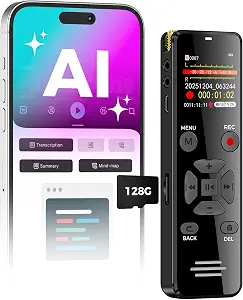 | Best for Post-Session Organization | Storage: 128 GB | Battery life: Up to 33 hours | Listed sound quality: 1536 Kbps HD | VIEW ON AMAZON | See Our Full Breakdown |
| Tonfarb Digital Voice Recorder, 136 GB |  | Best for Long Sessions | Total storage: 136 GB: 8 GB built-in and 128 GB TF card | Recording formats: MP3, WAV | Audio recording: 1536 kbps PCM | VIEW ON AMAZON | See Our Full Breakdown |
| Sunlan 16GB Digital Voice Recorder with Playback |  | Best Compact Pick | Storage: 16 GB | Recording format: WAV | Recording bitrate: 1536 kbps | VIEW ON AMAZON | See Our Full Breakdown |
| EVISTR L359 Digital Voice Recorder with 128GB Storage and AI Transcription |  | Best for Post-Session Transcription | Storage: 128 GB | Maximum recording bitrate: 3072 Kbps | Audio formats: MP3, WAV | VIEW ON AMAZON | See Our Full Breakdown |
| 136GB Digital Voice Recorder with Playback and Noise Reduction |  | Best for Long Sessions | Storage: 136GB total: 8GB built in + 128GB TF card | Recording formats: MP3, WAV | Microphones: Dual noise-reduction microphones | VIEW ON AMAZON | See Our Full Breakdown |
| EVIDA 128GB Digital Voice Recorder with Voice Activation and Playback |  | Best for Adjustable Voice Activation | Storage: 128 GB | Recording formats: MP3, WAV | Recording bitrates: MP3: 128 or 192 kbps; WAV: 1536 kbps | VIEW ON AMAZON | See Our Full Breakdown |
| 136GB Digital Voice Recorder with Playback, 9000 Hours Recording, Noise Reduction, A-B Repeat, MP3 Player, Password, Pink |  | Best for Marked Playback | Storage: 136GB total: 8GB built in + 128GB TF card | Recording time: Up to 68 hours | Supported formats: MP3, WAV | VIEW ON AMAZON | See Our Full Breakdown |
| 136GB Digital Voice Recorder with Voice Activation and Playback |  | Best for Long, Voice-Activated Sessions | Storage capacity: 136GB total: 8GB built-in memory and included 128GB TF card | Recording quality: 1536kbps | Microphone: Omnidirectional stereo microphone | VIEW ON AMAZON | See Our Full Breakdown |
| digital voice recorders for evp session | Storage | Microphone |
|---|---|---|
| HoTiyan 8GB Digital Voice Reco | 8 GB | Built-in stereo |
| EVISTR L357 64GB Digital Voice | 64 GB | Built-in stereo |
| Tonfarb 64GB Digital Voice Rec | 64 GB | — |
| AI Digital Voice Recorder 128G | 128 GB | — |
| Tonfarb Digital Voice Recorder | — | — |
| Sunlan 16GB Digital Voice Reco | 16 GB | Built-in mono with noise cancellation |
| EVISTR L359 Digital Voice Reco | 128 GB | Built-in mono |
| 136GB Digital Voice Recorder w | 136GB total: 8GB built in + 128GB TF card | — |
| EVIDA 128GB Digital Voice Reco | 128 GB | Built-in mono with noise cancellation |
| 136GB Digital Voice Recorder w | 136GB total: 8GB built in + 128GB TF card | — |
| 136GB Digital Voice Recorder w | — | Omnidirectional stereo microphone |
More Details on Our Top Picks
HoTiyan 8GB Digital Voice Recorder with Voice Activation and MP3 Playback
The HoTiyan H-10001 is a straightforward starting point for EVP sessions where simple controls matter more than large storage. Its built-in stereo microphone records WAV or MP3, and voice activation can reduce long stretches of silence taking up space. Compared with the 64GB EVISTR L357 and Tonfarb models, its 8GB capacity leaves less room for repeated or overnight sessions, especially at higher bitrates. The listed maximum of 560 recording hours applies at just 32 kbps, so I would not treat that figure as a guide to higher-quality capture. Up to 20 hours of recording per charge is useful for shorter outings, but extended sessions call for a charging plan. A-B repeat and variable-speed playback help review ambiguous passages, though the small screen and Micro USB connection feel basic beside newer options.
Pros:- Voice activation can limit silent segments and conserve storage.
- Records in WAV and MP3 with a built-in stereo microphone.
- A-B repeat and variable playback speed help examine brief sounds.
- Up to 20 hours of stated continuous recording supports shorter sessions.
Cons:- The 560-hour maximum depends on the lowest listed bitrate, 32 kbps.
- 8GB storage is modest for repeated sessions or higher-bitrate WAV files.
- Micro USB transfer and the small screen are less convenient than the EVISTR L357’s USB-C connection.
Best for: First-time EVP hobbyists planning short sessions who want voice activation and simple playback tools without a complicated feature set.
Not ideal for: People recording long overnight sessions or keeping extensive WAV archives; the 8GB storage and battery life are more limiting than the 64GB options here.
- Storage:8 GB
- Recording formats:MP3, WAV
- Microphone:Built-in stereo
- Recording bitrate options:192, 128, 64, 32 kbps
- Maximum stated recording time:560 hours at 32 kbps
- Continuous recording battery life:Up to 20 hours
- Transfer interface:Micro USB
- Playback features:A-B repeat, variable speed, MP3 playback
Our verdict“Choose the HoTiyan if you are new to EVP recording and value simple controls over long-session capacity.”
EVISTR L357 64GB Digital Voice Recorder with Playback
The EVISTR L357 stands out for giving EVP recorders more capture controls without moving into app-dependent transcription features. Its seven recording-gain levels and seven voice-activation sensitivity settings let buyers adapt pickup behavior to a quiet room or a location with steady ambient noise. That control is a practical distinction from the simpler HoTiyan, though it does not replace careful microphone placement or guarantee that faint sounds will be captured. The 64GB capacity also provides considerably more room than the HoTiyan’s 8GB for keeping multiple sessions. A metal body, compact size, and USB-C transfer suit portable use, while the stated 32-hour recording time still makes charging relevant for especially long sessions. Compared with the Tonfarb 64GB recorder, the EVISTR has a more clearly specified gain and sensitivity range; its one-inch screen may make file navigation less comfortable.
Pros:- Seven adjustable recording-gain levels offer more control over capture.
- Seven voice-activation sensitivity settings allow adjustment for different environments.
- 64GB storage and WAV/MP3 support accommodate multiple sessions.
- Compact metal construction and USB-C transfer work well for portable use.
Cons:- The stated 32-hour continuous recording time requires charging for longer sessions.
- The one-inch screen may make on-device file selection awkward.
- Its controls offer more adjustment than the simpler HoTiyan, which may be unnecessary for buyers seeking basic operation.
Best for: EVP hobbyists who want to tune gain and voice-activation sensitivity for different locations and transfer recordings over USB-C.
Not ideal for: Buyers who need a large, easy-to-read display or want a recorder explicitly described with one-touch recording and bookmarking.
- Storage:64 GB
- Recording formats:WAV, MP3
- Microphone:Built-in stereo
- Recording gain:7 adjustable levels
- Voice activation sensitivity:7 levels
- Continuous recording time:32 hours
- Battery:500 mAh lithium polymer
- File transfer:USB Type-C
Our verdict“Pick the EVISTR L357 if adjustable gain and voice-activation sensitivity matter more to you than a larger screen or extra playback tools.”
Tonfarb 64GB Digital Voice Recorder with Playback
For buyers who want to start capturing quickly and review clips on the recorder, the Tonfarb 64GB combines one-click recording with A-B looping and bookmarking. Those playback tools make it easier to return to a specific moment than the HoTiyan’s more basic repeat and variable-speed controls, while the Tonfarb’s 64GB storage is a substantial step up from that model’s 8GB. Voice activation can cut down on silent sections, but the advertised 48-hour recording figure is tied to MP3 at 32 kbps; the maximum listed PCM rate is 1536 kbps, so buyers should not assume those figures describe the same recording setting. There is also an unresolved power detail: the listing names both a 600 mAh battery and an included AAA battery. That makes power expectations less clear than on the rechargeable EVISTR L357.
Pros:- One-click recording and saving can reduce setup steps at a location.
- A-B loop and bookmarking help return to selected audio moments.
- 64GB storage supports a larger session library than the HoTiyan.
- Lists PCM recording up to 1536 kbps alongside WAV and MP3 formats.
Cons:- The 48-hour recording claim is tied to MP3 at 32 kbps, not the listed maximum PCM rate.
- Power details are inconsistent: the listing specifies a 600 mAh battery and one included AAA battery.
- USB 2.0 is listed, rather than the EVISTR L357’s USB-C transfer.
Best for: EVP recordists who want fast one-click starts and on-device bookmarking to revisit possible events during review.
Not ideal for: Buyers who need unambiguous battery specifications or expect the maximum recording duration while capturing at the highest PCM setting.
- Storage:64 GB
- Audio formats:MP3, WAV
- Maximum PCM recording quality:Up to 1536 kbps
- Maximum stated recording time:Up to 48 hours at MP3 32 kbps
- Battery details:600 mAh listed; one AAA battery included
- Screen:1.44 inches
- Interface:USB 2.0
- Playback features:A-B loop, bookmarking
Our verdict“Choose the Tonfarb if quick recording and bookmarking matter to your review process, but verify the power setup and recording settings before relying on its duration claims.”
AI Digital Voice Recorder 128GB with Transcription & Summarization
The YIVIDA L359 takes a different approach from the simpler EVISTR L357: it pairs recording with AI transcription, summaries, and mind maps. For EVP work, those tools may help organize session notes or spoken context after a recording, but a generated transcript is not a substitute for listening to the original audio when evaluating faint or ambiguous sounds. Its 128GB storage is double the capacity of the 64GB EVISTR and Tonfarb models in this batch, leaving more room for saved sessions. The listing also specifies up to 33 hours of battery life and 1536Kbps HD sound quality, though it gives limited detail about app compatibility and the recording workflow. Wired OTG connectivity, with no Bluetooth, makes file access less flexible than a recorder using a familiar direct transfer connection. I would choose this for organization features, not solely for audio capture.
Pros:- AI transcription, summaries, and mind maps add post-session organization tools.
- 128GB storage exceeds the 64GB EVISTR L357 and Tonfarb models here.
- Up to 33 hours of stated battery life can cover extended recording use.
- Noise reduction and voice activation are included.
Cons:- AI-generated text should not replace listening to original recordings for ambiguous EVP review.
- Wired OTG connectivity has no Bluetooth and may complicate file access.
- App compatibility details are limited, which makes the transcription workflow harder to evaluate.
Best for: Technically comfortable EVP users who record spoken session notes and want AI tools to organize or transcribe material after recording.
Not ideal for: Buyers who want a simple standalone recorder, clear details about app compatibility, or wireless transfer; its AI workflow and OTG connection may add friction.
- Storage:128 GB
- Battery life:Up to 33 hours
- Listed sound quality:1536 Kbps HD
- Noise reduction:Yes
- Voice activation:Yes
- Connectivity:Wired OTG
- Weight:65 g
- Languages supported:113
Our verdict“Choose the YIVIDA if AI-assisted organization is part of your process, rather than if you want the simplest recorder for capturing and reviewing audio.”
Tonfarb Digital Voice Recorder, 136 GB
The Tonfarb 136GB is the capacity-and-runtime pick for EVP recordists who want to keep sessions on the device and minimize charging stops. Its stated up to 68 hours of battery life exceeds the figures listed for the HoTiyan and EVISTR L357, while 136GB total storage—8GB built in plus an included 128GB TF card—offers far more room than the 64GB Tonfarb model. Dual microphones, noise reduction, voice activation, and one-touch recording provide a useful set of capture features, and A-B repeat supports later listening. The tradeoff is that the headline capacity depends on the included card, and the stated weight is inconsistent: 97 g in the description and 100 g in the specifications. It also has a relatively small 1.44-inch screen, so this choice favors endurance and storage over easy on-device navigation.
Pros:- Up to 68 hours of stated battery life is longer than the listed figures for the HoTiyan and EVISTR L357.
- 136GB total capacity includes 8GB built-in storage and a 128GB TF card.
- Dual microphones, noise reduction, and voice activation support varied recording setups.
- One-touch recording and USB-C transfer simplify starting sessions and moving files.
Cons:- The 136GB total depends on the included 128GB TF card.
- Weight is listed inconsistently as 97 g and 100 g.
- The 1.44-inch screen may make on-device browsing less convenient than file transfer to a computer.
Best for: EVP hobbyists planning long or repeated sessions who value substantial onboard-plus-card storage and fewer charging breaks.
Not ideal for: Buyers who need a clearly stated weight, a larger navigation display, or storage that does not depend on an included TF card.
- Total storage:136 GB: 8 GB built-in and 128 GB TF card
- Recording formats:MP3, WAV
- Audio recording:1536 kbps PCM
- Battery:1100 mAh rechargeable lithium
- Battery life:Up to 68 hours
- Screen:1.44 inches
- Connections:USB-C, 3.5 mm headphone jack
- Listed weight:97 g in description; 100 g in specifications
Our verdict“Pick the Tonfarb 136GB if long recording sessions and generous storage matter more than a larger screen or fully consistent product specifications.”
Sunlan 16GB Digital Voice Recorder with Playback
The Sunlan 16GB is the lightest, simplest fit here for short EVP sessions where pocketability matters more than a large archive. Its one-button recording and voice activation make it easy to start a session without working through menus, while WAV recording at 1536 kbps gives you an uncompressed format for reviewing captured sounds. Compared with the EVIDA VR01, it has far less storage and fewer file-management tools, but its 35-gram body is easier to carry unobtrusively. Noise reduction may help with steady background sound, though it cannot separate a faint voice from room noise by itself. The mono microphone also records only one channel, and the listed seven-hour playback time is a limit for lengthy review sessions. Choose it for compact, straightforward use, not maximum capacity or advanced controls.
Pros:- Compact 35-gram body is easy to carry between locations
- WAV recording at 1536 kbps preserves an uncompressed audio file
- Voice activation and one-button recording simplify session starts
- A-B repeat helps replay a selected section during review
Cons:- 16GB capacity is limited compared with the 128GB EVISTR L359 and EVIDA VR01
- Built-in mono microphone records only one audio channel
- Listed playback time is seven hours
Best for: EVP beginners who want a lightweight recorder for short sessions and simple WAV capture
Not ideal for: Researchers who record long investigations or need stereo microphones, large storage, or extended playback
- Storage:16 GB
- Recording format:WAV
- Recording bitrate:1536 kbps
- Microphone:Built-in mono with noise cancellation
- Recording time:Up to 30 hours
- Playback time:Up to 7 hours
- Connectivity and audio:USB; 3.5 mm headphone jack
- Dimensions and weight:0.5 × 1.4 × 3.3 inches; 35 g
Our verdict“Pick the Sunlan for brief, portable EVP sessions where simple controls matter more than capacity or extended playback.”
EVISTR L359 Digital Voice Recorder with 128GB Storage and AI Transcription
The EVISTR L359 is the pick for investigators who want abundant recording space and a path from session audio to searchable notes. Its 128GB storage and up-to-3072 Kbps recording bitrate give it more capacity and a higher stated maximum bitrate than the Sunlan 16GB, which is better suited to smaller, simpler sessions. One-touch controls and a HOLD switch can reduce accidental button presses while recording, and password encryption adds a layer of file privacy. The standout distinction is AI transcription in 113 languages through the AI DVR Link app; that can speed up organizing spoken material, but it is a separate app-dependent feature, not a substitute for listening carefully to EVP audio. The built-in microphone is mono, and file transfers use wired USB-C or OTG rather than wireless sharing. Choose this model for large archives and assisted review, not a wireless workflow.
Pros:- 128GB storage supports a large archive of session recordings
- Maximum recording bitrate of 3072 Kbps and WAV support offer high-bitrate capture
- Voice activation and one-touch controls simplify recording
- Password encryption and a HOLD switch support privacy and reduce accidental inputs
Cons:- AI transcription and summaries depend on the AI DVR Link app
- OTG file transfers require a wired connection
- Built-in microphone is mono
Best for: EVP researchers who record frequently, need substantial file capacity, and want app-based transcription for organizing speech
Not ideal for: Buyers who want stereo capture, wireless file transfers, or transcription features that work without a companion app
- Storage:128 GB
- Maximum recording bitrate:3072 Kbps
- Audio formats:MP3, WAV
- Microphone:Built-in mono
- Continuous recording time:Up to 33 hours
- Transcription languages:113 via AI DVR Link app
- Connectivity:USB Type-C; wired OTG
- Dimensions and weight:0.39 × 1.25 × 4 inches; 65 g
Our verdict“Choose the L359 if you want high-capacity EVP recording paired with app-based transcription and do not need stereo or wireless transfers.”
136GB Digital Voice Recorder with Playback and Noise Reduction
This 136GB recorder is aimed at investigators who want long stretches of recording without frequent battery stops. Its stated up-to-68-hour battery life is the strongest listed runtime in this batch, while dual noise-reduction microphones distinguish it from mono options such as the Sunlan 16GB and EVIDA VR01. The extra microphone hardware may suit room-based sessions where capturing sound is the priority, though the supplied data does not specify stereo recording, so I would not assume two-channel files. Storage combines 8GB built in with a 128GB TF card, meaning the full capacity depends on that card being present. USB-C and one-touch operation keep basic file handling straightforward, but the product information gives less detail about recording bitrate and durability than the EVISTR L359. This is a runtime-and-capacity choice, not the clearest pick for buyers who need documented audio settings.
Pros:- Up to 68 hours of stated battery life suits long recording periods
- 136GB combined storage supports extended file retention
- Dual noise-reduction microphones are a differentiator from mono-mic models
- USB-C and one-touch recording simplify routine operation
Cons:- Full 136GB capacity depends on the included or installed 128GB TF card
- Recording bitrate is not specified in the supplied product data
- No waterproof rating is listed
Best for: Investigators planning extended sessions who value long stated battery life and high storage capacity
Not ideal for: Buyers who need clearly specified recording bitrates, verified stereo capture, or a recorder with stated water resistance
- Storage:136GB total: 8GB built in + 128GB TF card
- Recording formats:MP3, WAV
- Microphones:Dual noise-reduction microphones
- Battery:1100mAh rechargeable lithium battery
- Battery life:Up to 68 hours
- Connectivity:USB-C
- Weight:97 g
Our verdict“Choose this model for long sessions and substantial storage, provided its unspecified recording bitrate is acceptable for your workflow.”
EVIDA 128GB Digital Voice Recorder with Voice Activation and Playback
The EVIDA VR01 stands out for control over when voice activation responds: its six sensitivity levels let users adjust the trigger rather than rely on a single setting. That is useful when a quiet room or low-level background sound makes activation behavior hard to predict, though it still calls for checking the setting before a session. Its WAV mode records at 1536 kbps, and four folders, bookmarks, and playback controls help organize and revisit files. Compared with the Sunlan 16GB, the EVIDA offers much more storage and more review tools; compared with the EVISTR L359, it lacks the listed app transcription feature and higher maximum bitrate. Its mono microphone keeps it simple, while the C battery requirement and lack of a headphone jack constrain field review. Pick it for adjustable activation and file organization, not convenient headphone monitoring.
Pros:- Six voice-activation sensitivity levels allow adjustment for different room conditions
- WAV recording at 1536 kbps and MP3 options offer format flexibility
- Bookmarks and four folders help manage and revisit session files
- 128GB capacity and up to 54 hours of continuous recording support extended use
Cons:- No headphone jack for direct private monitoring
- Requires one C battery
- Built-in microphone is mono
Best for: EVP users who want to tune voice-activation sensitivity and organize many recordings into separate folders
Not ideal for: Researchers who need a headphone jack for private playback or prefer a rechargeable battery
- Storage:128 GB
- Recording formats:MP3, WAV
- Recording bitrates:MP3: 128 or 192 kbps; WAV: 1536 kbps
- Microphone:Built-in mono with noise cancellation
- Voice activation:6 sensitivity levels
- Maximum continuous recording time:Up to 54 hours
- Connectivity:USB 2.0
- Battery:1 C battery
- Dimensions and weight:2.59 × 0.41 × 0.77 inches; 3.35 oz
Our verdict“Choose the EVIDA VR01 if adjustable voice activation and organized playback matter more than app transcription or headphone monitoring.”
136GB Digital Voice Recorder with Playback, 9000 Hours Recording, Noise Reduction, A-B Repeat, MP3 Player, Password, Pink
For EVP review, the useful distinction in this pink 136GB recorder is not its headline recording-hour claim but its A-B repeat and password protection. A-B repeat lets you loop a chosen passage while checking a faint sound, and password protection can help keep stored files private. Like the other 136GB model in this batch, it lists dual noise-reduction microphones, voice activation, a rechargeable 1100mAh battery, and USB-C. The supplied data gives up to 68 hours of recording time; the separate 9000-hour claim in the product title is not supported by that spec, so I would not use it as a session-planning figure. Compared with the EVIDA VR01, this model adds A-B repeat but does not specify adjustable activation sensitivity or recording bitrates. Its storage also relies on a 128GB TF card for the full capacity, and the pink finish will not suit every field setup.
Pros:- A-B repeat supports repeated listening to selected audio sections
- Password protection adds privacy for stored recordings
- USB-C supports straightforward wired file transfers
- Dual noise-reduction microphones and voice activation support hands-off recording
Cons:- 136GB total capacity depends on a 128GB TF card
- The product title’s 9000-hour claim conflicts with the listed up-to-68-hour recording time
- Recording bitrate is not specified, and the pink finish may not suit every buyer
Best for: EVP reviewers who want to loop selected passages and prefer a rechargeable recorder with USB-C file transfer
Not ideal for: Buyers who want bitrate details, a neutral finish, or a clearly documented recording-time figure beyond the stated 68 hours
- Storage:136GB total: 8GB built in + 128GB TF card
- Recording time:Up to 68 hours
- Supported formats:MP3, WAV
- Microphones:Dual noise-reduction microphones
- Battery:1100mAh rechargeable lithium battery
- Connectivity:USB-C
- Features:Voice activation, A-B repeat, password protection
- Weight:97 g
Our verdict“Pick this model if A-B repeat is central to your review routine and you are comfortable relying on the listed 68-hour recording specification.”
136GB Digital Voice Recorder with Voice Activation and Playback
For EVP sessions where recording time and hands-off operation matter, this model pairs 136GB of total storage with voice activation, so you can save space during quieter periods. Its omnidirectional stereo microphone and stated 1536kbps recording quality offer a useful starting point for capturing sound from around a room, while PCM noise reduction may help limit some background noise. Compared with the Sunlan 16GB Digital Voice Recorder, it provides far more room for extended sessions; unlike the AI transcription models in this roundup, it focuses on recording and playback rather than automated text features. The tradeoff is that voice activation may miss faint or quiet sounds, which can matter during EVP work. Its several functions may also take time to learn, and battery life varies with use.
Pros:- 136GB total capacity supports extensive recordings before file transfers are needed.
- Voice activation can reduce silent stretches and conserve storage.
- Omnidirectional stereo microphone is suited to capturing sound from multiple directions.
- Type-C connection and headphone jack support file transfer and direct playback monitoring.
Cons:- Voice activation may not capture very quiet sounds consistently, a concern for EVP sessions.
- Multiple functions and file-management options may take practice to use confidently.
- Battery life can vary, and the included 128GB TF card may be unnecessary for buyers with other storage needs.
Best for: EVP hobbyists who record long sessions, want voice activation to reduce empty recording time, and need ample onboard-plus-card storage.
Not ideal for: Buyers who want the simplest possible recorder or who need uninterrupted capture of very faint sounds that voice activation might not trigger.
- Storage capacity:136GB total: 8GB built-in memory and included 128GB TF card
- Recording quality:1536kbps
- Microphone:Omnidirectional stereo microphone
- Noise reduction:PCM ten-core triple digital noise reduction
- Voice activation:Yes
- Recording battery life:Up to 33 hours
- Playback battery life:Up to 24 hours
- Connections:3.5mm headphone jack and Type-C port
Our verdict“Choose this recorder for long sessions and generous storage, but use continuous recording when faint sounds matter more than conserving memory.”

How We Picked
I ranked these recorders around the demands of an EVP session: dependable basic capture, practical storage for longer recordings, playback that makes reviewing material manageable, and controls that a buyer can understand before recording. I also considered whether extra features—such as voice activation, noise reduction, or AI transcription—serve a clear workflow need or could complicate a session. The product names and stated features provide a starting point, but they do not establish microphone sensitivity, audio fidelity, or performance in a quiet room, so I avoid treating those claims as proof of EVP capture quality.
The EVISTR L359 ranks first for combining 128GB storage with AI transcription, while the L357 ranks as the more straightforward playback-oriented choice. High-capacity models follow where their listed features suit extended recording, but similar specifications do not justify treating them as interchangeable winners. More basic options remain relevant for buyers who want fewer extras or a smaller stated capacity. I favor clear use cases and useful recording workflows over the largest number on a feature list.
| digital voice recorders for evp session | Microphone |
|---|---|
| HoTiyan 8GB Digital Voice Reco | Built-in stereo |
| EVISTR L357 64GB Digital Voice | Built-in stereo |
| Tonfarb 64GB Digital Voice Rec | — |
| AI Digital Voice Recorder 128G | — |
| Tonfarb Digital Voice Recorder | — |
| Sunlan 16GB Digital Voice Reco | Built-in mono with noise cancellation |
| EVISTR L359 Digital Voice Reco | Built-in mono |
| 136GB Digital Voice Recorder w | — |
| EVIDA 128GB Digital Voice Reco | Built-in mono with noise cancellation |
| 136GB Digital Voice Recorder w | — |
| 136GB Digital Voice Recorder w | Omnidirectional stereo microphone |
Factors to Consider When Choosing Digital Voice Recorders For Evp Sessions
Choosing a recorder for EVP work is less about chasing the longest feature list and more about preserving recordings you can review carefully. I’d match the device to session length, the amount of processing you’re comfortable with, and how you plan to listen afterward.
Prioritize an Original Recording Over Processing
Features such as noise reduction can change the sound presented during playback, which may make interpretation harder if you cannot compare it with the untouched file. For EVP sessions, I’d treat processing as an optional listening aid rather than a guaranteed improvement. Check whether the recorder lets you keep a clean original or disable processing during capture. A common mistake is choosing a device because “noise reduction” sounds like a way to reveal quieter voices. It may also alter faint background sounds that you want to evaluate. Keep copies of original files before applying edits or filters on another device.
Match Storage to Your Session and Review Habits
More storage can reduce the need to clear files between sessions, but capacity alone does not tell you how long the recorder can capture at a given quality setting. Recording format, sample rate, and file-management tools all affect usable recording time, and those details are not established by capacity claims alone. If you record long sessions, ask how easily files can be transferred and backed up. Smaller-capacity models may still suit shorter investigations when you routinely archive recordings. Avoid assuming an advertised number of hours applies to every setting or continuous recording scenario. Leave room for test recordings and preserve files you may want to revisit.
Treat Voice Activation as a Convenience, Not a Default
Voice activation can reduce sections of silence, which may make recordings quicker to review and use less storage. The tradeoff is that a quiet or gradual sound may not trigger capture, depending on the recorder’s threshold and surroundings. This is a meaningful risk in EVP work, where a sound of interest may be faint or brief. If you use activation, test it in the same room and with similar background conditions before relying on it. For an important session, continuous recording is the safer starting point when the device allows it. Compare both approaches on a short trial rather than trusting the feature name.
Choose Playback and File Transfer for Your Review Process
On-device playback is useful for checking whether a session recorded and for quickly marking moments to revisit, but small controls or limited navigation can slow detailed listening. A recorder that transfers files easily to a computer or phone may be more useful for careful comparison, headphones, and organized archiving. Before buying, look for details about supported file formats, connection type, and whether recordings can be copied without special software. Do not assume that MP3 playback means the recording format or transfer workflow will suit every device. If you plan to compare original and processed audio, make file access a higher priority than built-in playback extras. A simple naming and backup routine can matter more than another playback mode.
Decide Whether AI Transcription Fits the Job
AI transcription can help create a rough index of a long recording, especially when you want to locate sections for a closer listen. It is not a substitute for listening to the audio: transcription tools can misread quiet speech, environmental sounds, or ambiguous material. Check what the feature actually processes, whether it requires an account or internet access, and how transcripts are stored. Those details are not clear from a feature label alone. Buyers who want a basic capture-and-review process may be better served by a recorder without AI extras. If transcription is appealing, use it as a search aid and verify every relevant passage against the original recording.
Test the Recorder Before a High-Stakes Session
A feature list cannot establish how a device behaves in your room, with your placement, or at the sensitivity you need. Run a short test for handling noise, room ambience, button sounds, battery behavior, and file transfer before taking the recorder to an important location. Place it on a stable surface rather than handling it while recording, since contact noise can obscure quiet sounds. Make a test file at the settings you plan to use and confirm that it opens on your review device. Keep spare power and storage plans appropriate to the session length. This basic rehearsal can reveal workflow problems that capacity and feature descriptions do not.
Frequently Asked Questions
Is the EVISTR L359 a better choice than the L357 for EVP sessions?
I’d choose the L359 if its 128GB storage and AI transcription suit a workflow that includes lengthy recordings and quick indexing. The L357 is the more direct option if playback and capture are your main needs and you do not expect to use transcription. Neither product name establishes microphone sensitivity or recording quality, so the extra features do not prove that the L359 will capture quieter sounds. Check file-transfer and transcription requirements before deciding. If you want a simple setup, fewer features may be an advantage rather than a limitation.
Should I record with voice activation during an EVP session?
I would not make voice activation the default until you have tested it in the room where you plan to record. Its threshold may omit very quiet or gradual sounds, while continuous recording preserves more of the session at the cost of larger files and longer review. The EVIDA 128GB, HoTiyan 8GB, and one of the 136GB models list voice activation, but that feature alone does not establish how adjustable or sensitive it is. Try a short comparison recording and listen for missed starts. For a session you cannot repeat, continuous capture is the more cautious choice when available.
Do I need 128GB or 136GB of storage for EVP recordings?
Not necessarily: the right capacity depends on how long you record, the file settings, and how often you move sessions off the device. The HoTiyan’s stated 8GB may suit short, frequently archived sessions, while the 128GB and 136GB options give more room before file management becomes necessary. Capacity claims do not specify recording time at every quality setting, so do not infer an exact session count from the number alone. Confirm how files transfer and whether you can make backups easily. A reliable archive routine can matter more than buying the largest stated capacity.
Can noise reduction or AI transcription prove that a recording contains an EVP?
No. Noise reduction may change audio, and transcription may misinterpret unclear sounds, so neither feature can verify what a recording contains. The 136GB noise-reduction model and the AI-enabled EVISTR L359 or 128GB recorder offer tools that may help with review, but they are not evidence of paranormal activity. Keep the original recording and treat processed audio or transcripts as prompts for further listening. Compare interpretations with the unprocessed file and note the settings used. This approach helps separate a device’s convenience features from conclusions about the sound.
What should I check before relying on one of these recorders for a long session?
Before a long session, make a test recording and confirm that the battery lasts for your intended duration, the selected settings are active, and the file can be opened on your review device. Check whether the recorder can capture continuously or might stop because of a setting, storage limit, or power issue. Practice transferring and backing up a file before the session, rather than discovering a format or connection problem afterward. Set the recorder on a stable surface to reduce handling noise. Bring a plan for spare power and storage, and keep the original files unchanged.
Conclusion
Best overall: I’d choose the EVISTR L359 for its combination of 128GB storage and AI transcription, provided those extras fit your review process. Best value in features: the EVISTR L357 is my pick for buyers who want 64GB and playback without prioritizing AI tools. Best for beginners: the HoTiyan 8GB suits someone starting with shorter sessions and a simple feature set, though its smaller capacity calls for regular file management. Best for high-capacity recording: compare the 136GB Tonfarb and other 136GB models by their specific controls, not storage alone. Best for specific needs: choose a voice-activation model only after testing its trigger behavior, or the noise-reduction option only if you can preserve and review an original recording. For EVP sessions, I’d make reliable capture and easy file review the deciding factors, ahead of processing claims.