
Finding the right plants for an apartment means balancing a few competing priorities: low maintenance, small footprints, tolerable light conditions, and — for renters with pets — safety. In this roundup, I compare five popular live plant options sold online and rank them by how well they fit apartment life specifically, not just how pretty they look in a product photo.

Turn your quiet moments into listening time
- Thousands of audiobooks, podcasts and originals
- Listen on your phone, tablet or Echo — also offline
- Cancel anytime
Two picks stand out early. The Altman Plants Snake Plant earns my top spot because it shrugs off low light, irregular watering, and general neglect — the three things that kill most apartment plants. The Costa Farms Money Tree is my pick for anyone who wants a ready-to-display, pet-safe plant that arrives in a decorative pot with zero setup. The main tradeoff throughout this guide is between single specimen plants (predictable, polished, one care routine) and assorted multi-packs (better value and variety, but you accept a random selection with mixed care needs).
Key Takeaways
- The snake plant is the most forgiving choice for low light and missed waterings, making it the best single plant for most apartments.
- The money tree is the only pick that arrives pre-potted in a decorative planter and is described as pet-safe, but it may need recovery time after shipping.
- Multi-packs (the 4-pack, 3-pack, and 6-pack) offer the best per-plant value but ship random assortments with varying care requirements.
- The 6-pack uses tiny 2-inch pots best suited for grouped arrangements, not for filling a shelf with full-size plants.
- None of these options lets you choose exact varieties, so buyers who want a specific plant should buy individual specimens instead.
| Altman Plants Live Snake Plant (Laurentii), 4 in Pot |  | Best Overall | Plant: Snake Plant (Sansevieria Laurentii) | Pot size: 4.25-inch grower pot | Expected height: About 10 inches | VIEW ON AMAZON | See Our Full Breakdown |
| Costa Farms Money Tree Live Indoor Plant in Decorative Pot |  | Best Display-Ready Pick | VIEW ON AMAZON | See Our Full Breakdown | |||
| Essential Houseplant Collection, 4-Pack | 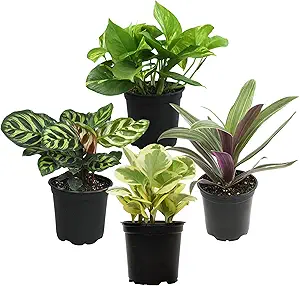 | Best Value Variety Pack | Quantity: 4 plants | Pot size: 4.25-inch nursery pots | Varieties: Assorted; Pothos, Philodendron, Calathea, Dracaena, Ficus, Syngonium, Peperomia, Ferns | VIEW ON AMAZON | See Our Full Breakdown |
| Costa Farms Live Indoor Plants Starter Collection, 3-Pack |  | Best for Beginners | Quantity: 3 plants | Pot size: 4 inches | Plant types: Assorted; e.g., Peace Lily, Snake Plant, Fern, Pothos | VIEW ON AMAZON | See Our Full Breakdown |
| Easy-to-Grow Live Indoor Houseplants, Assorted 6-Pack |  | Best for Small-Scale Styling | Quantity: 6 plants | Pot size: 2 inches | Approximate height: 4–6 inches | VIEW ON AMAZON | See Our Full Breakdown |
| apartment plant | Pot size | Quantity |
|---|---|---|
| Altman Plants Live Snake Plant | 4.25-inch grower pot | — |
| Costa Farms Money Tree Live In | — | — |
| Essential Houseplant Collectio | 4.25-inch nursery pots | 4 plants |
| Costa Farms Live Indoor Plants | 4 inches | 3 plants |
| Easy-to-Grow Live Indoor House | 2 inches | 6 plants |
More Details on Our Top Picks
Altman Plants Live Snake Plant (Laurentii), 4 in Pot
If I had to recommend one plant to one apartment dweller without knowing anything about their habits, it would be this snake plant. The Sansevieria Laurentii tolerates low, medium, or bright light, survives drought thanks to its succulent-like leaves, and grows slowly enough that it won’t outgrow a windowsill in a season. Compared with the assorted multi-packs in this lineup, it removes the biggest variable in plant buying: you know exactly what species is arriving and exactly how to care for it.
The tradeoffs are mostly cosmetic. It ships in a basic grower pot, so unlike the Costa Farms Money Tree, it isn’t display-ready out of the box — a cheap cache pot solves that in an afternoon. At roughly 10 inches tall, it’s also smaller than some buyers expect, though its vertical yellow-edged leaves still read as architectural on a shelf. Compared with the 6-pack’s tiny 2-inch plants, this one delivers immediate visual presence rather than something you have to grow into a look.
Pros:- Thrives in low, medium, or bright light
- Drought tolerant; forgiving of missed waterings
- Variegated foliage adds height and color to shelves and desks
- Known species means a predictable, single care routine
Cons:- Ships in a plain grower pot, not a decorative planter
- At about 10 inches tall, may be smaller than expected
- Will eventually need repotting as it matures
Best for: Beginners, frequent travelers, and anyone with low-light apartments who wants a single reliable plant
Not ideal for: Buyers who want a decorative pot included or a large floor plant on day one
- Plant:Snake Plant (Sansevieria Laurentii)
- Pot size:4.25-inch grower pot
- Expected height:About 10 inches
- Light needs:Low, medium, or bright light
- Watering:Occasional / minimal
- Special features:Drought tolerant, air-purifying
- Indoor/outdoor:Both
Our verdict“The most forgiving, most predictable plant in this lineup, and the one I’d point most apartment dwellers toward first.”
Costa Farms Money Tree Live Indoor Plant in Decorative Pot
Where the snake plant wins on toughness, the Money Tree wins on presentation. It arrives pre-potted in a decorative planter, which no other option here can claim — everyone else ships in nursery or grower pots. The braided trunk and shaped canopy give it a finished, styled look that suits entry tables, desks, and nightstands without any effort on your part. At 12–16 inches, it also occupies a middle ground: taller and more decorative than the snake plant, without demanding the floor space of a true large plant.
The standout apartment-specific feature is that it’s described as pet-safe for cats and dogs, which immediately separates it from popular-but-toxic options like pothos and philodendron — varieties that show up randomly in both multi-packs here. The main caveat is shipping stress: Costa Farms advises letting it rest in indirect light for 24 hours if it arrives droopy, and the lack of included long-term watering instructions means you’ll want to look up its care yourself. Compared with the snake plant, it’s also needier about consistent watering, so it’s a better fit for someone who enjoys a small routine rather than total neglect.
Pros:- Arrives pre-potted in a decorative planter
- Described as safe for cats and dogs
- Braided trunk and canopy create a polished look
- Compact enough for desks, shelves, and side tables
Cons:- May arrive stressed and need recovery time
- No specific watering or long-term care instructions included
- Less drought-tolerant than the snake plant
Best for: Pet owners, gift-givers, and renters who want a plant that looks styled the moment it’s unboxed
Not ideal for: Total hands-off owners or anyone unwilling to research basic watering needs
Our verdict“The best choice when you want instant, pet-safe decor rather than a project.”
Essential Houseplant Collection, 4-Pack
This 4-pack splits the difference between the single-specimen picks and the tiny 6-pack. You get four greenhouse-grown plants in 4.25-inch nursery pots, drawn from apartment-friendly genera like Pothos, Philodendron, Peperomia, and Calathea. That’s enough variety to style a whole windowsill or bookshelf from one order, at a per-plant cost that undercuts buying four individual plants. Compared with the Costa Farms 3-pack, the pots are slightly larger and the expected height around 10 inches means the plants have more presence on arrival.
The catch, as with every assorted pack here, is that you don’t choose the varieties. A Calathea and a Pothos have very different tolerances — one sulks with tap water and dry air while the other grows through almost anything — so be prepared to learn two to four care routines instead of one. Pet owners should also note that pothos and philodendron, both common inclusions, are toxic to cats and dogs, making the Money Tree the safer route for animal households. For renters without pets who enjoy the variety, though, this collection offers the best balance of value and plant size in the lineup.
Pros:- Four plants per order for strong per-plant value
- Features popular, mostly low-maintenance indoor varieties
- Greenhouse-grown and hand-selected for health
- Larger pots than the 6-pack, so plants arrive with real presence
Cons:- Varieties vary with availability and can’t be selected
- Different plants may need different light and watering schedules
- Possible inclusion of pet-toxic varieties like pothos
Best for: Plant-curious renters who want to fill multiple surfaces at once and don’t mind mixed care routines
Not ideal for: Pet owners concerned about toxic varieties, or buyers who want to pick exact species
- Quantity:4 plants
- Pot size:4.25-inch nursery pots
- Varieties:Assorted; Pothos, Philodendron, Calathea, Dracaena, Ficus, Syngonium, Peperomia, Ferns
- Light:Partial sun; bright, indirect light recommended
- Expected height:About 10 inches
- Soil moisture:Regular watering
- Indoor/outdoor:Both
Our verdict“The smartest way to green up several spots in one order, provided you can adapt to a mixed care routine.”
Costa Farms Live Indoor Plants Starter Collection, 3-Pack
This 3-pack earns the beginner slot for a simple reason: reduced commitment. Three plants is enough to learn the rhythm of plant care without the overwhelm of the 4-pack’s mixed genus list or the 6-pack’s six tiny propagations to keep alive. The assortment may include a Peace Lily, Snake Plant, Fern, or Pothos — all varieties with well-documented, beginner-friendly care — and Costa Farms ships them in specialized protective packaging, which addresses the scariest part of ordering live plants online.
Compared with the Essential 4-Pack, you get one fewer plant and slightly smaller 4-inch pots, but the protected shipping and the brand’s nursery consistency make it a gentler entry point for someone buying their first live plants sight unseen. The drawbacks are familiar: the varieties are random and not selectable, and cold-weather shipping can still damage tropical plants, so ordering in a heat wave or deep winter is a gamble. It also makes a genuinely good housewarming gift for a fellow renter, which is not something I’d say about a plant that requires expertise.
Pros:- Three beginner-friendly plants with simple care needs
- Lower commitment than larger multi-packs
- Specialized protective packaging for safer delivery
- Makes a ready-made housewarming gift
Cons:- Plant varieties are random and can’t be chosen
- Cold-weather shipping poses damage risk
- 4-inch pots are smaller than the 4-pack’s
Best for: First-time plant owners and gift-givers who want an easy, low-stakes starting point
Not ideal for: Buyers in extreme climates worried about shipping damage, or anyone wanting specific species
- Quantity:3 plants
- Pot size:4 inches
- Plant types:Assorted; e.g., Peace Lily, Snake Plant, Fern, Pothos
- Brand:Costa Farms
- Care level:Low maintenance, beginner-friendly
- Packaging:Specialized protective shipping packaging
Our verdict“The least intimidating way to start an apartment plant habit, with gifting appeal built in.”
Easy-to-Grow Live Indoor Houseplants, Assorted 6-Pack
The 6-pack plays a different game than everything else here. With six plants in 2-inch pots standing just 4–6 inches tall, it isn’t meant to fill a room — it’s meant for grouped arrangements, terrarium-style displays, windowsill clusters, and DIY projects like building your own mixed planter. If your apartment aesthetic leans toward a cluster of small plants rather than one statement specimen, this is the most cost-effective route to that look. Compared with the 4-pack, you get 50% more plants, but each one starts half the size.
Those small pots carry real responsibilities. Tiny volumes of soil dry out and saturate quickly, so these plants need more attentive watering than any other pick here — the opposite of the snake plant’s neglect-proof routine. The rotating assortment (pothos, peperomia, spider plants, croton, ficus, syngonium, begonia) is a genuine surprise each time, which is fun for hobbyists and frustrating for planners. I’d position this as a second or third purchase for someone already keeping plants alive, rather than a first for a complete novice.
Pros:- Six plants per order, the most in this lineup
- Ideal scale for grouped planters and DIY projects
- Rotating assortment keeps repeat orders interesting
- Cheapest per-plant way to build a cluster display
Cons:- Plants arrive small at 4–6 inches tall
- 2-inch pots dry out fast and need attentive watering
- Selection is a surprise with mixed care needs
Best for: Hobbyists styling grouped planters, terrarium displays, or windowsill clusters on a budget
Not ideal for: Beginners or anyone wanting large, display-ready plants immediately
- Quantity:6 plants
- Pot size:2 inches
- Approximate height:4–6 inches
- Varieties:Rotating; pothos, peperomia, spider plant, croton, ficus, syngonium, begonia
- Best use:Decor, grouped planters, DIY projects
- Care level:Easy to grow, but small pots need frequent checks
Our verdict“A budget-friendly building block for small-scale plant styling, best for people who already enjoy the maintenance.”

How We Picked
I judged every option against the realities of apartment living rather than general houseplant appeal. My criteria fell into four buckets. Tolerance for imperfect conditions came first: apartments tend to have limited light, dry air, and owners who travel, so plants that forgive neglect ranked higher than finicky specimens. Footprint mattered next — a plant that fits a windowsill, desk, or narrow shelf beats one that needs floor space. Predictability was a factor too: options with a known species and care routine scored better than mystery assortments, though I rewarded multi-packs that offset that uncertainty with value and variety. Finally, I weighed out-of-the-box readiness, meaning whether a plant arrives display-ready or needs repotting and recovery time. Where two products tied on care ease, I favored the one with the clearer fit for small-space living.
Factors to Consider When Choosing Apartment Plants
Before ordering any live plant online, a handful of apartment-specific factors will do more to determine success than the plant itself. Here’s what I weigh when choosing.Light reality check
Be honest about your apartment’s light. North-facing windows and interior rooms qualify as low light, which is where the snake plant clearly outperforms everything else in this lineup. Money trees, pothos, and peperomia want bright, indirect light, while calatheas and ferns — possible inclusions in the assorted packs — are the fussiest about conditions. Ordering a light-loving plant for a dim unit is the most common way apartment plants die.
Your actual maintenance appetite
There’s a difference between “low maintenance” and “no maintenance.” The snake plant tolerates near-total neglect; the money tree wants a consistent routine; the 6-pack’s tiny pots need frequent checks because small soil volumes swing between dry and soaked fast. Match the plant to your real habits, not your aspirational ones.
Pets and toxicity
If you share your apartment with a cat or dog, toxicity matters more than aesthetics. Pothos, philodendron, and some ficus varieties — all common in the assorted packs — are toxic if chewed. The money tree is the only pick here described as pet-safe, which is why it earned its slot despite being needier than the snake plant.
Single specimen vs. multi-pack
Single-plant orders give you a known species, one care routine, and predictable appearance. Multi-packs give you value and variety but randomize what arrives. My general rule: start with one specimen you research, then graduate to packs once you can read a plant’s needs.
Shipping season and arrival care
Live plants are vulnerable in transit, especially in temperature extremes. Order in mild seasons when possible, unbox immediately, and give new plants a day or two of gentle indirect light to recover — even healthy shipments experience some shock. Choosing sellers with protective packaging, as the Costa Farms 3-pack uses, reduces the risk further.
Frequently Asked Questions
Which plant in this roundup is easiest to keep alive in a dark apartment?
The Altman Plants Snake Plant is the clear winner for dim conditions. Sansevieria tolerates low, medium, and bright light equally well, and its drought tolerance means missed waterings won’t finish it off. By contrast, the assorted packs may include calatheas or ferns that struggle without bright, indirect light, and the money tree prefers consistent illumination to maintain its canopy. If your apartment has one cloudy window and a busy schedule, the snake plant removes nearly every common failure point at once.
Are any of these plants safe for cats and dogs?
The Costa Farms Money Tree is the only pick explicitly described as pet-safe for both cats and dogs, which makes it the safest default for animal households. The assorted multi-packs are riskier because pothos, philodendron, and certain ficus varieties — all frequent inclusions — are toxic if chewed, and you can’t select which plants you receive. If you have pets but want variety, the safest approach is buying individual known species rather than gambling on a random assortment.
Why can’t I choose which plants I get in the multi-packs?
Growers ship assortments based on nursery availability, seasonal stock, and plant health at packing time, which is why every multi-pack in this lineup lists rotating or variable varieties. This keeps per-plant costs down but means your order is a surprise. Buyers who need predictability — for pet safety, light matching, or a specific aesthetic — should order single-specimen plants like the snake plant or money tree instead, where the species, size, and care routine are all known in advance.
What should I do if a plant arrives stressed or damaged?
First, unbox it fully and inspect the leaves and soil rather than repotting immediately — most transit stress resolves on its own. Give the plant 24 to 48 hours of gentle, indirect light and resist fertilizing or heavy watering while it recovers, which is exactly the protocol Costa Farms recommends for the money tree. Trim any badly damaged leaves with clean shears. If a plant arrives dead or badly broken, photograph the packaging and plant before disposal, since sellers typically replace losses when documented promptly.
Is the 6-pack actually a good deal if the plants are so small?
It depends entirely on what you want. If you’re hoping for display-ready plants to fill shelves, the 2-inch pots and 4–6 inch heights will disappoint, and the 4-pack or a single larger specimen serves that goal better. But if you want to build grouped planters, style a windowsill cluster, or enjoy growing small plants into larger ones, the per-plant cost is hard to beat. Just factor in that tiny pots demand attentive watering, so the money you save upfront comes back as time spent on maintenance.
Conclusion
The right pick depends less on the plants themselves and more on who’s buying them. For the hands-off renter — busy, traveling, low light — the Altman Plants Snake Plant is the obvious first choice, with its tolerance for neglect and any light level. For the pet owner or gift-giver, the Costa Farms Money Tree wins on pet safety and its decorative, display-ready arrival. The budget-minded decorator filling multiple surfaces should grab the Essential Houseplant 4-Pack for its balance of plant size and variety, while the complete beginner is better served by the gentler three-plant Costa Farms Starter Collection. Finally, the hobbyist styling terrariums and grouped planters will get the most from the tiny-but-plentiful 6-pack. Whatever you choose, order in mild weather, unbox promptly, and give every new plant a few quiet days under indirect light before judging it.