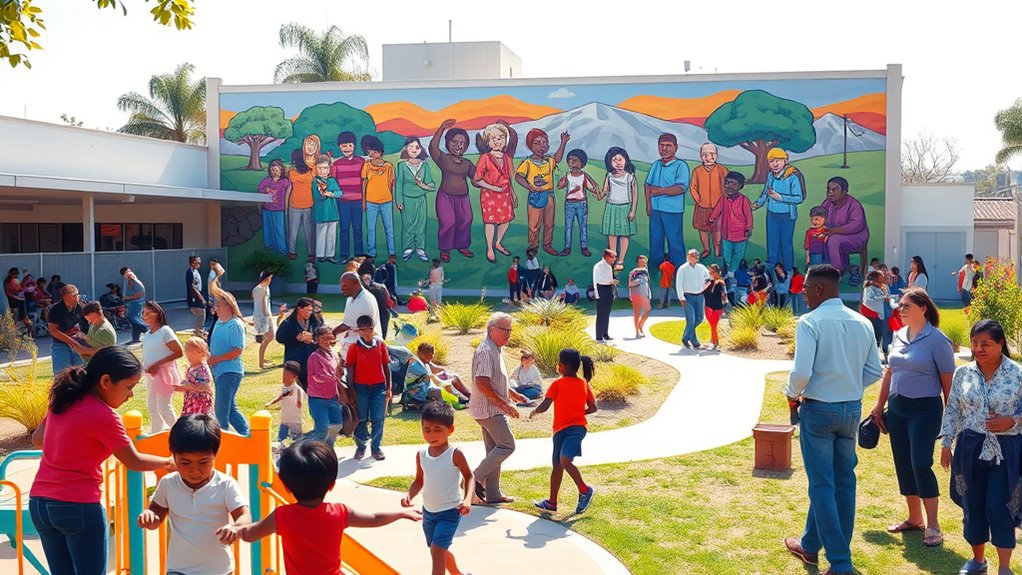

To guarantee equitable community services, focus on fair resource allocation that prioritizes areas with high needs, and actively involve community voices to address disparities. Understand the cultural backgrounds and values of diverse groups to improve communication and build trust. Use feedback from community forums and surveys to identify gaps and adjust services accordingly. Continuous effort and engagement help create inclusive, resilient spaces. Keep exploring to discover effective strategies for fostering lasting equity.

Turn your quiet moments into listening time
- Thousands of audiobooks, podcasts and originals
- Listen on your phone, tablet or Echo — also offline
- Cancel anytime
Key Takeaways
- Conduct data analysis and community feedback to identify and address service gaps and disparities.
- Allocate resources strategically to underserved groups, prioritizing high-need areas for fairness.
- Incorporate cultural competency training for staff to improve communication and build trust with diverse communities.
- Engage community members through forums and advisory groups to ensure services reflect actual needs.
- Maintain ongoing evaluation and flexibility to adapt resource distribution and programming for continuous equity.

Have you ever wondered if everyone in your community has equal access to essential services? Addressing this question begins with understanding how resources are allocated and recognizing the importance of cultural competency. Resource allocation is the process of distributing funds, personnel, and facilities in a way that meets the diverse needs of your community. When resources are unevenly distributed, some groups may find themselves underserved, which fosters inequality. To promote fairness, you need to evaluate which areas or populations require more support and ensure these needs are prioritized. This involves analyzing data, listening to community voices, and adjusting allocations dynamically. For example, if a neighborhood has high language barriers or limited transportation options, directing additional resources there can dramatically improve access to healthcare, education, and social services. Incorporating color accuracy in project planning can also help ensure visual materials are accessible and inclusive for diverse audiences.
Equal access depends on fair resource distribution and understanding community cultural needs.
Cultural competency plays a critical role in delivering equitable services. It’s not enough to simply have resources available; you need to understand the cultural backgrounds, values, and experiences of the people you serve. When service providers are culturally competent, they can communicate more effectively, build trust, and reduce misunderstandings. This means training staff to recognize cultural differences and adapt their approaches accordingly. By doing so, you create an environment where everyone feels respected and understood, which encourages community members to seek help when they need it. For instance, offering multilingual support or culturally relevant programming can make a significant difference for non-English speakers or communities with unique traditions.
Integrating resource allocation with cultural competency requires ongoing effort and community involvement. You should actively seek feedback from diverse groups to identify gaps and barriers. This might involve community forums, surveys, or forming advisory committees that include representatives from different cultural backgrounds. Such engagement ensures that the services you provide are tailored to actual needs rather than assumptions. Additionally, you need to be flexible and willing to reallocate resources as circumstances evolve or new issues emerge. This proactive approach helps prevent disparities from widening and ensures that your community’s services remain accessible and inclusive.
Ultimately, creating equitable community services isn’t a one-time effort; it’s an ongoing process that demands attention to how resources are distributed and how well those services respect cultural differences. By prioritizing fair resource allocation and enhancing cultural competency, you empower all community members to thrive. You foster a sense of belonging and trust that encourages everyone to participate fully in community life. When done intentionally, these strategies can transform your community into a more just, inclusive, and resilient place where everyone’s needs are recognized and addressed.
Frequently Asked Questions
How Can Communities Measure the Effectiveness of Equitable Services?
You can measure the effectiveness of equitable services by collecting relevant data and engaging your community. Use surveys, focus groups, and feedback forms to gather insights on how well services meet diverse needs. Monitor participation rates across different groups and analyze outcomes to identify gaps. Active community engagement helps you understand real impact, enabling you to adjust programs for better inclusivity and fairness, ensuring your efforts truly serve everyone.
What Funding Sources Support Equitable Community Service Initiatives?
Imagine you’re launching a program to serve underserved neighborhoods. You can tap into funding partnerships with local businesses or seek grant opportunities from government agencies and nonprofits. These sources provide essential resources to support equitable community service initiatives. By actively pursuing diverse funding options, you guarantee your project gets the necessary financial backing, helping you build sustainable, impactful programs that address community needs and promote fairness across all populations.
How Do Cultural Differences Impact Service Equity?
Cultural differences impact service equity by highlighting the need for cultural sensitivity and addressing language barriers. You must recognize diverse cultural norms and communication styles to guarantee everyone feels understood and valued. When you adapt your approach to respect cultural backgrounds, you reduce misunderstandings and improve access to services. By actively listening and providing multilingual resources, you create an inclusive environment where all community members can benefit equally.
What Role Do Local Governments Play in Ensuring Equity?
You have a vital role in ensuring equity, as local governments shape policies that promote fairness. You can foster community engagement by actively listening to diverse voices, ensuring marginalized groups aren’t left out in the cold. Through thoughtful policy development, you address disparities and build trust. Remember, a chain is only as strong as its weakest link, so your efforts to promote inclusivity strengthen the entire community.
How Can Technology Improve Access to Community Services?
Technology can improve access to community services by bridging digital divides through affordable internet and devices. You can leverage online platforms for community outreach, making information and resources more accessible to underserved populations. By implementing user-friendly apps and websites, you guarantee everyone can easily find and utilize services. This approach promotes equity, helping all community members connect with essential resources regardless of their technological access or background.
Conclusion
By committing to equitable community services, you hold the key to opening doors of opportunity for everyone. Think of your efforts as planting seeds in a diverse garden—each one representing a person’s unique needs. When you nurture these seeds with fairness and inclusion, the garden flourishes, symbolizing a stronger, more vibrant community. Remember, your actions are the sunlight and water that help growth thrive—creating a world where everyone can bloom.
Products Worth Considering
multilingual community resource guide
As an affiliate, we earn on qualifying purchases.
As an affiliate, we earn on qualifying purchases.